The BIOSONATOR from ULTRAWAVES, a spin-off of Hamburg University of Technology founded in 2001, is a plug-and-play ultrasound unit. It makes organic matter easier to digest, in municipal sewage sludge as well as in agricultural, industrial and food-waste biogas plants.
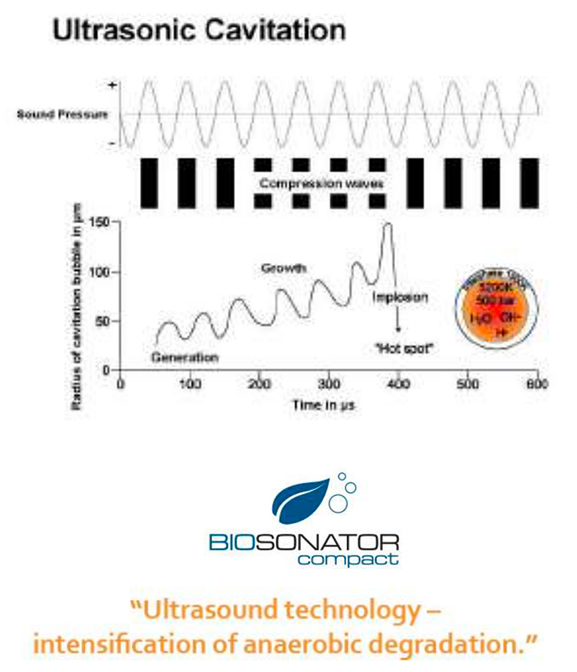
Ultrasound at 20 kHz creates microscopic bubbles that implode with local pressures of around 500 bar. These shear forces crack cell walls and flocs, release enzymes and enlarge the surface the bacteria can attack. Because the oscillators sit directly in the medium, the cavitation is “hard”: according to ULTRAWAVES about ten times as effective as indirect sonication.
Takes a partial stream, usually 30–50 % of the daily feed from the secondary digester, and cuts coarse fibres.
Eccentric screw pump with frequency converter sets the flow.
3–10 oscillators immersed in the medium, amplitude controlled automatically.
Treated material goes back to the digester; remote monitoring around the clock.
For sewage treatment plants with anaerobic digesters and for aerobic sludge stabilisation. Particularly useful where digesters run at their load limit or sludge disposal is expensive.
Manufacturer figures, ULTRAWAVES GmbH.
For plants from about 300 kW electrical or comparable BioCNG capacity, mesophilic or thermophilic, with up to 15 % dry matter.
Manufacturer figures, ULTRAWAVES GmbH; payback depends on the site.
| Plant | Country | Type | Size | Since |
|---|---|---|---|---|
| Pearl Distillery, Ongole | India | Distillery | – | 2012 |
| Yanzhou WWTP | China | Wastewater | 750,000 PE | 2016 |
| Shek Wu Hui WWTP | Hong Kong | Wastewater | 350,000 PE | 2014 |
| Arrudas WWTP | Brazil | Wastewater | 2,000,000 PE | 2010 |
| Dąbrowa Górnicza WWTP | Poland | Wastewater | 200,000 PE | 2008 |
| Trier WWTP | Germany | Wastewater | 170,000 PE | 2015 |
| Ense biogas plant | Germany | Biogas | 2,500 kW | 2015 |
| Bordesholmerland | Germany | Biogas | 1,600 kW | 2011 |
| Bispingen | Germany | Biogas | 1,100 kW | 2008 |
PE = population equivalent. Source: ULTRAWAVES reference lists.
A 2.5 MW plant in Germany that has run a BIOSONATOR since 2015. The video opens on YouTube; nothing is loaded from YouTube until you click.
Discuss a trial at your plantSend us your plant data. We check the potential together with ULTRAWAVES.